
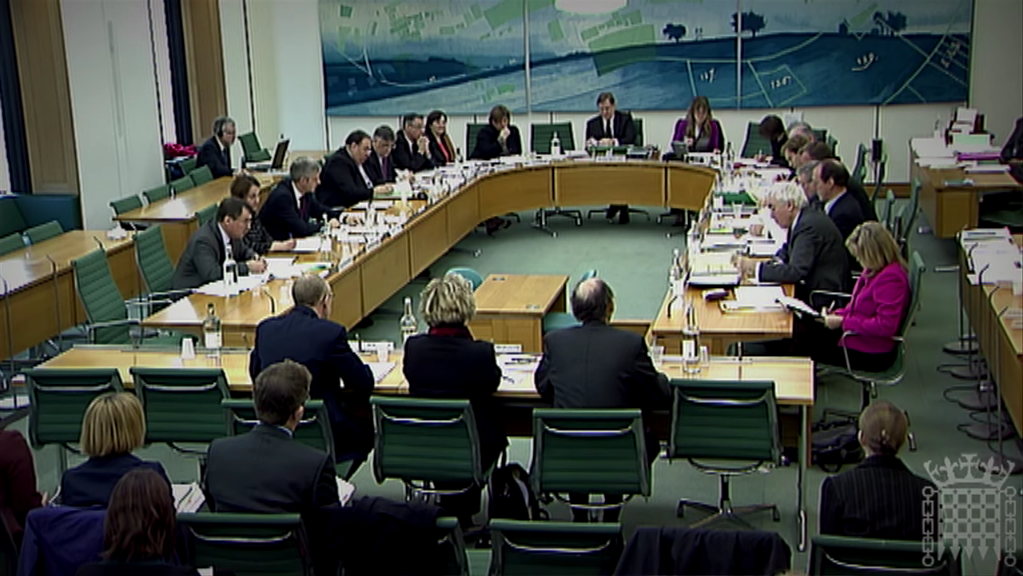
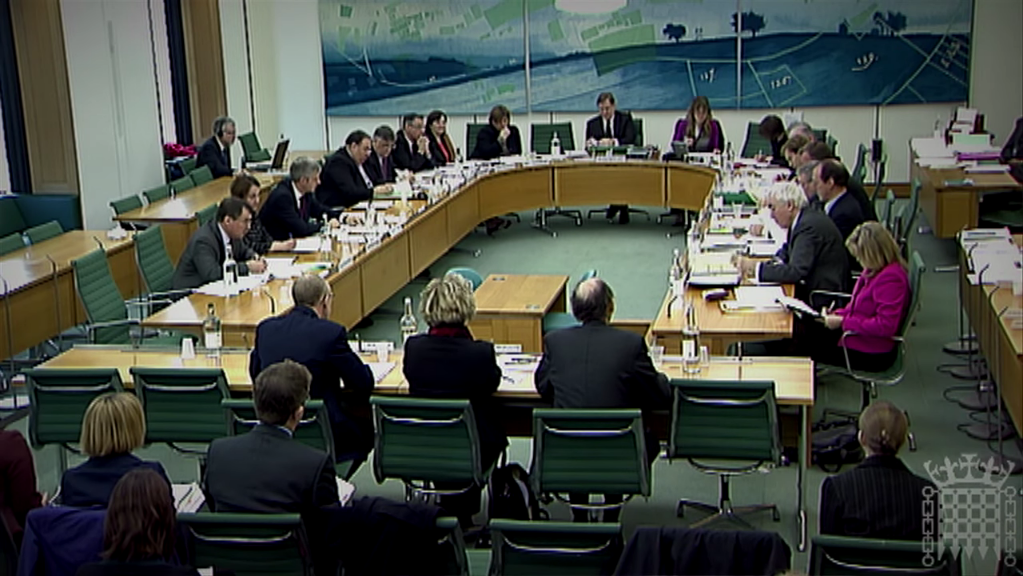
When talking about the US political system Woodrow Wilson famously said ‘Congress in Committee is Congress at work, Congress on the floor is Congress on show’. His observation may also be true of the House of Commons in the UK political system.
Select Committees have emerged as an essential part of parliamentary scrutiny and are arguably the most effective way of holding the government to account. So, what are Select Committees and how do they work?

What is a Select Committee and how are they made up?
A Select Committee is a group of parliamentarians (MPs or Lords) who are appointed to scrutinise an aspect of governance in detail.
How Select Committee work is defined under the Standing Orders (rules) of the House of Commons and House of Lords.
Select Committees have between 11 and 14 members. They include MPs or Lords from across different political parties. However, when Commons Committees, they also reflect the overall party balance in the House of Commons. This means that a party with a majority in the House of Commons will have the most seats on most Committees. The distribution of seats across the different committees is organised by the Committee of Selection which organises the membership of Select Committees.
There are a few exceptions to this rule on party balance, however:
Public Accounts Committee – This is always chaired by a Senior Opposition MP. It is currently chaired by Geoffrey Clifton-Brown (Conservative).
Environmental Audit Committee – This has membership drawn from other Select Committees and so its membership does not necessarily mirror the House of Commons as a whole.
Joint Committees – As Joint Committees are drawn from both the Lords (where there is no party in majority) and the Commons, the party balance in them does not match that of the House of Commons.
What are the different types of Select Committee?
There are broadly four different types of Select Committee:
Departmental Select Committees – These Select Committees only exist in the House of Commons and are set up to scrutinise a particular government department. In that role they will scrutinise aspects of governance such as:
- Departmental Spending
- The policies put forward by the department
- The implementation of the policies
- Departmental appointments (for example, the Education Select Committee will scrutinise the appointment of a new Chair of OFSTED)
Topical Select Committees – These are Select Committees that scrutinise an aspect of governance that cuts across different areas of government. For example:
The Public Accounts Committee – Scrutinises government expenditure across departments.
The Women and Equalities Committee – Scrutinises the commitment of government to issues of equality across government departments.
House of Lords Select Committees – These are Select Committees only made up of members of the House of Lords. Rather than a departmental focus, they have a broader and longer-term remit on areas of governance. The current House of Lords Select Committees include:
- The Science and Technology Committee
- The Public Services Committee
- The Economic Affairs Committee
- The Constitution Committee
Joint Committees – These are Committees made up of both MPs and Lords. Current examples include:
- The Joint Committee on Human Rights
- The Joint Committee on National Security Strategy
How do Select Committees differ from Public Bill Committees?
Select Committees often get confused with Public Bill Committees. However, they are different for a number of reasons:
Ad-Hoc v Permanence – Public Bill Committees are set up on an ad hoc basis to scrutinise a particular bill passing through the House of Commons. Select Committees, however, are permanent (they are often called standing committees).
Purpose – Public Bill Committees are set up with the sole purpose of scrutinising the legislation they are linked to. Whilst Select Committees may do some pre-legislative and post-legislative scrutiny, their role is wide-ranging, looking at all aspects of governance.
Membership – The membership of Public Bill Committees is dictated by party whips. This means that Public Bill Committees usually end up following the party line. However, since 2010, Select Committee membership has been chosen via an open election, meaning Select Committees show more independence.

How did the Wright Reforms improve the effectiveness of Select Committees?
The Wright Reforms were a set of House of Commons reforms made in 2010 following a report authored by Tony Wright, the then Chair of the Reform of the House of Commons Select Committee.
A number of changes were made to the House of Commons, but the changes to Select Committees were amongst the most significant:
- The election of members of Select Committees – The Wright Reforms proposed that seats on a Select Committees should be elected in a secret ballot by whereby MPs could vote for anyone else in their own political party. Prior to this, the membership of Select Committees had been chosen by party whips. This gave party leaders significant control over Select Committees, which tended to toe-the-party-line rather than show independent thought. The change to the way Select Committees are chosen has significantly increased the independence of Select Committees.
- The election of Select Committee Chairs – The Wright Reforms also saw Select Committee Chairs being elected by a secret ballot of the whole house. This has again increased the independence of the process. In addition, becoming a Select Committee Chair is now seen as a viable alternative to seeking career progression through becoming a Shadow Minister or a Government Minister.
How do Select Committees usually operate?
Select Committees choose their own lines of enquiry. This is an important part of keeping them independent on government. Most Select Committees go through the following process:
- Decide on an issue to investigate
- Ask for written evidence
- Hold oral evidence sessions
- Go on fact-finding trips
- Produce reports and make recommendations to the government
- Receive a formal response from the government
Importantly, apart from sensitive topics like issues surrounding national security, all the above are completed transparently. Members of the public can attend Select Committee hearings and can submit evidence to the Committee.
What are some recent case studies of Select Committees Reports?

Education Select Committee
Focus: Ofsted’s work with schools
Inquiry Launched: June 2023
Background: In 2023, the Education Select Committee launched an enquiry into Ofsted’s work with schools. This followed a number of concerns into the way Ofsted handled its inspections, concerns bought into public attention my the death of Ruth Perry, a Headteacher whose school had recently been downgraded following an OFSTED inspection.
Evidence Collection: The Committee took written evidence and held three oral evidence sessions where they heard from:
- Government Ministers such as Nick Gibb, the Minister for Schools
- The Ofsted Chief Inspector, Amanda Spielman
- Teaching Union representatives such as Daniel Kebede, the General Secretary of the NEU
- School Executives such as Steve Rollett, the Deputy Chief Executive of a School’s Trust
Report: The first report was 68-pages long and was published in January 2024. The Committee made 49 recommendations, including:
- Ofsted must carefully consider the inquest report into the death of Ruth Perry and consider its approach to dealing with school leaders. (1)
- That school inspections should be reduced in frequency, but extended in depth. (2)
- Ofsted should consider giving schools a greater period of notice before inspections. (3)
- Ofsted should consider changes to the ‘single word’ grading following a school inspection. (4)
Government Response: The Government responded to the report in April 2024 in a 17-page response. They said:
(1) That they had accepted the Coroner’s finding in full and were actively working to address some of the issues raised.
(2) That the disagreed with this recommendation, particularly in cases where schools had previously been deemed inadequate or ‘requires improvement’. However, they were aiming to spend more money to reduce the backlog in inspections as a result of COVID-19.
(3) That they agreed in principle with this recommendation, however, Ofsted needed to find a balance between giving adequate notice and being able to see schools how they normally operate, rather than simply schools who are acting so as to pass an inspection.
(4) That they felt the single-word grade was an important way for parents’ to get an overall view of the school and was an important way that Ofsted monitored schools who may need a more in-depth review in the future. However, it said it remained open to consulting on alternative systems.
Home Affairs Select Committee
Focus: Police and Government Response to the Public Disorder in the Summer of 2024
Inquiry Launched: November 2023
Background: Following the horrific murder of three young school children at the hands of Axel Rudabakana in Southport in July 2024, widespread disorder and riots emerged across the UK. The Home Affairs Select Committee set up a an inquiry as to both why this disorder started and how it was subsequently managed by the police and the government.
Evidence Collection: The Committee took written evidence and held two oral evidence sessions where they heard from:
- Police Officers such as the Chief Constables of Humberside, Staffordshire, Cleveland and South Yorkshire
- Civil Servants such as Andrew Johnson the Deputy of the Police Powers Unit at the Home Office
- National Police Leaders such as the Chair of the Association of Police and Crime Commissioners, Emily Spurrell
Report: The first substantive report was published in April 2025 and was 46 pages long. The Committee made 21 conclusions and recommendations to the government. These included:
- The national system for policing should enhance its ability to monitor and respond to social media (1)
- The government should set out how its strategic plans for Police forces supporting each other (‘mutual aid’) help to prepare the police nationally for situations like the disorder. (2)
- The lack of information from Merseyside Police following the original incident may have contributed to a vacuum in which misinformation grew. Media guidelines for Police forces should be reviewed (3)
Government Response: The Government responded in July 2025 with a 10-page response.
(1) All options are being considered to increase the ability of the Police to monitor social media, including innovative use of technology.
(2) Considerations are being made in preparation for a White Paper (draft of a Bill) as to how to tackle these challenges going forward.
(3) The government confirmed that the CPS is reviewing their recommendations about the release of suspect information to find a better balance between public knowledge of an incident and the risk of court proceedings being hurt by social media discussion.

Defence Select Committee
Focus: Defence in the Grey Zone
Inquiry Launched: September 2023
Background: The Defence Committee launched an inquiry into what they called the ‘Grey Zone’. By this, they mean Britain’s ability to fight in new spheres of warfare, such as cyberwarfare. The inquiry was launched, in part, as a reaction to Russia’s Invasion of Ukraine in 2022 and the subsequent increase in cybersecurity threats. This inquiry started in the 2019-2024 Parliament, but was interrupted by the 2024 General Election. Given its importance, the inquiry was resumed in the 2024 Parliament.
Evidence Collection: The Committee took written evidence and held four oral evidence sessions where they heard from:
- Hybrid Warfare specialists such as James Appathurai from NATO
- Intelligence experts such as Sir Alex Younger, the former Chief at MI6
- Military figures such as Air Commodore Matt Bressani
Report: The first substantive report by the Committee was published in July 2025 and was 38 pages long. The Committee made 14 conclusions and recommendations. These included that:
- The Ministry of Defence should consider how its ‘grey zone’ capabilities could be further extended (1)
- In particular, the MoD should consider the role of the Royal Navy and Royal Fleet Auxiliary in protecting undersea internet cables (2)
- The MoD should report back on precise plans on how it plans to protect national infrastructure from cyberattack (3)
- The Government should create a dedicated Homeland Security Minister to oversee ‘grey zone’ preparation (4)
Government Response: The Government responded to the report in October 2025. They said that:
(1) They agreed with this recommendation and the next Strategic Defence Review would highlight increased measures to deal with threats in the ‘grey zone’
(2) They agreed with this recommendation and said that the Royal Navy will assume a greater role in dealing with the threat to undersea cables.
(3) They agreed to undertake a review and report back with one calendar year.
(4) They said that national security and the issues raised in the report fall across a number of government departments. The roles were now coordinated by the newly created Chief Secretary to the Prime Minister and there was no need for an explicit Homeland Security Minister.

How does the Commons Liaison Committee differ from other Select Committees?
The Commons Liaison Committee is a unique Select Committee. It is made up of the Chairs of the other Commons Select Committees. This means its MPs are normally always senior and experienced parliamentarians. Its role is to coordinate the other Select Committees. However, it has become famous due to the modern convention that the Prime Minister attends the Liaison Committee three times a year to answer questions. The scrutiny in these sessions is much stronger than the Prime Minister faces in weekly Prime Minister’s Questions.
Boris Johnson faced a brutal time from the Liaison Committee in 2022 when he faced it just days before he resigned and whilst Ministers were resigning en masse from his government:
Keir Starmer most recently faced the Commons Liaison Committee on July 21st 2025:
What are the strengths and weaknesses of Select Committees?
Some of the potential strengths of Select Committees are:
- They can investigate issues in much more depth than possible in the chamber of the House of Commons. They produce detailed reports for consideration by the Government.
-
They work across party lines and often in a bi-partisan manner. This gives Select Committees more legitimacy than the partisan politics that normally takes place in the chamber.
-
They are increasingly becoming involved in pre-legislative scrutiny to help develop bills before they get to the House of Commons.
-
They can get input from people beyond Politics that can help inform them.
-
They allow MPs to move from being generalists to being specialists through their work on a Committee.
-
They allow for far more detailed questioning on Ministers than is possible in the Chamber of the House of Commons.
-
Since the Wright Reforms of 2010, Select Committees have been able to become more independent due to the way they are selected.
-
The Commons Liaison Committee is headed by the chairs of the other Select Committees and questions the Prime Minister directly up to three times per year. These sessions are much more intense for the Prime Minister than other question time and can lead to more detailed scrutiny.
- The Government is formally required to respond to Select Committee reports and this enforces them to account for their actions.
- Select Committee reports often capture media attention and can kick-start public debates on political issues.
However, some of the potential weaknesses of Select Committees are:
-
They cannot force the Government to adopt a recommendation and many of their reports are largely ignored.
- Turnover of MPs on Select Committees may mean they do not build up as much expertise as would be possible if they remained on the Committee for longer.
-
They have no power to force (subpoena) witnesses to attend. Witnesses also do not give evidence under oath (as they would do in the US Congress).
-
Whilst they are more bipartisan than the Chamber, Committees are still made up in proportion to the size of the parties in the House.
-
Committees are often not very well-resourced, whereas government ministers have an army of advisors and researchers, Committee budgets do not match this.
Article Summary
Select Committees are arguably the best form of scrutiny that Parliament possesses. Their methodical approach to issues and their detailed reports can force government to publicly explain or amend their policy or position. The strength of Select Committees has particularly grown since the Wright Reforms in 2009. However, there are still a number of limits to Select Committees and their power over legislation is exceptionally limited, particularly compared to Committees in the United States.
Glossary of Terms
Commons Liaison Committee – A particular Select Committee made up of the Chairs of the other House of Commons Select Committees. They scrutinise the Prime Minister three times per year.
Departmental Select Committee – A Select Committee that scrutinises a particular government department. For example, the Home Affairs Select Committee scrutinises the work of the Home Office.
Joint Select Committee – A Select Committee that is made up of members of both the House of Commons and the House of Lords.
Public Accounts Committee – A topical Select Committee that scrutinises government expenditure across departments. It is always chaired by a senior Opposition MP.
Public Bill Committee – An ad hoc committee set up in the House of Commons to scrutinise a bill at Committee Stage.
Select Committee – A group of MPs or Lords that form to scrutinise a particular government department or function.
Topical Select Committee – A Select Committee that monitors an issue that cuts across government departments. For example, the Environmental Audit Committee scrutinises environmental policy across government.
Whips – MPs or Lords who are responsible for ensuring party discipline and making sure their MPs ‘toe the party line’.
Wright Reforms – A set of reforms to the House of Commons proposed in 2009 and implemented in 2010. Their biggest impact was on the constitution of Select Committees.
Last Updated – 24.10.25